

Experimenting with Estimates: The Study of Paying Estimated Taxes for Trusts
Understanding the basic mechanics

ABOUT THE AUTHOR: Tim Harden is a CPA with Brady Martz, who works with estates, trusts, and individuals to provide tax saving strategies and compliance services. He has an extensive background in the field of trust, estate, and gift tax, including the areas of probate, asset protect, and complex trust and estate planning with tax compliance, including roughly 16 years as an attorney in this area prior to changing his focus to public accounting.
Igor has been helping the Doctor with the tax filings for his family holdings while the Doctor focuses on his scientific explorations. Igor’s goal is to explain to the Doctor the various concepts the accountants have been proposing, because he doesn’t like to act ultra vires and wants to make sure the Doctor is on board. It is a difficult task, though, due to both the Doctor’s limited attention span for these matters and the variety of issues that can pop up in this area. But since it is nearing the September 15th deadline for third quarter estimated payments, he pushes ahead and tackles the issues as they are relevant trust by trust.
Trust Estimates, in General
The first item on the agenda is to explain to the Doctor that trusts and estates must make estimated payments like individuals. This surprises him, although it really should not at this point. Igor shows him Internal Revenue Code Section 6654(l)(1), which applies the estimated tax requirement to trusts and estates. The most obvious thing right away is that the requirement has an exception. This exception applies in the case of death. In that situation, there is no estimated tax requirement for any tax year ending before the date two years after the date of death. 26 USC 6654(1)(2). This applies to the estate of the decedent and to any trust that had been treated as a grantor trust with respect to the decedent or to which the residue (remainder) of the decedent’s estate passes under his will. Id. The most common types of entities this rule would apply to are decedent’s estates, revocable grantor trusts, and testamentary trusts. The Doctor has many trusts of which he is the trustee, but none of them fall into this category for this year.
Mechanics of Trust Estimates
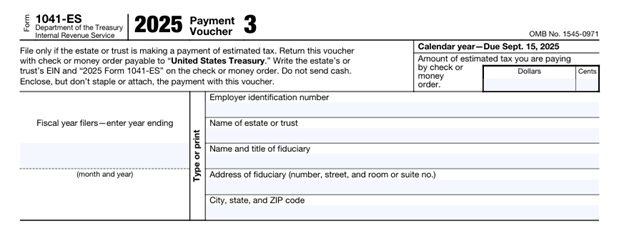
Moving on to the mechanics, the statute provides that the estimated tax be paid, as for individuals, in four installments by the following dates: April 15th, June 15th, September 15th, and January 15th of the next year. 26 USC 6654(c). Estimates are paid using form 1041-ES, which looks like this (editor’s note: with some changes in manner of payment for 2026 to be discussed below):
Safe Harbor Calculations
The amount of each payment is generally one-fourth of the total required annual payment. 26 USC 6654(d)(1)(A). The required annual payment is equal to the lesser of: 90% of the current year’s tax, or 100% of the tax for the prior year, as long as it was a full twelve months. 26 USC 6654(d)(1)(B). The latter means that in the case of a short year, the annual amount must be equal to at least 90% of the current year’s tax. Finally, if the prior year AGI was over $150,000, then the 100% is changed to 110%.
Oftentimes the 100% or 110% of the prior year amount is referred to as the “safe harbor” amount. This is because as long as at least that amount is paid, then there will be no estimated tax penalties, providing a safe harbor from penalties. This is especially useful for trusts that hold a lot of business interests, because for them income may vary unpredictably from year to year. To use the 90% rule, a projection of the current year’s income would have to be made, and, more importantly, it would have to be accurate enough to be reliable. Depending on the circumstances, that may not be practical. This is why the Doctor’s accountants, along with many others Igor encountered while doing research, are more comfortable recommending safe harbor payments based on the prior year’s tax. Igor and the Doctor have been using this method for the current year, due to a very similar conversation in June, and the Doctor agrees in between glances at his watch that continuing in this manner seems prudent.
Annualizing Income
The statute also gives the option of annualizing income to calculate the estimated tax requirement. 26 UCS 6654(d)(2). This means that the income received by the trust is considered based on what time in the year it was received. Therefore, if a trust receives more of its income toward the end of the year, annualizing could be beneficial because lower estimated payments would be required in the early parts of the year.
Trusts calculate the quarterly installments under this method a little differently than individuals. First, the tax liability for the annualized income is calculated. The annualized income is the year-to-date income through the relevant period. For individuals, that period is through the due date for the quarterly payment as set forth above. 26 USC 6654(d)(2)(B)(i). However, for a trust, the income is for the period “ending before the date 1 month before the due date for the installment.” 26 USC 6654(l). That means the income considered for annualization of a trust’s quarterly estimated payments is through February 28 (April 15 payment), April 30 (June 15 payment), July 31 (September 15 payment), and November 30 (January 15 payment). Then the respective applicable percentages are applied to the annualize income for the 1st through 4th quarters: 22.5%, 45%, 67.5%, and 90%). Igor, sharp as ever, notices that December is not included in these periods, which means that a fair amount of income can be realized in December without the trust or estate having to pay estimated taxes on it. The tax would simply be due by the due date for the tax return.
An additional item that Igor notices is that IRS Notice 87-32 clarifies that the income distribution deduction is allowed to be taken into account for simple trusts. To explain in a simplified manner for one of limited attention span like the Doctor, simple trusts are generally taxed only on income considered as added to trust principal, which in practice is generally capital gains. The tax on the rest of the income is paid by the beneficiaries. Sometimes capital gains can be distributed out, but that is less common. Therefore, a simple trust will only pay income tax on the capital gains for the year, while the other items of income like interest and dividends are distributed out to the beneficiaries. These payments are treated as a distribution by the trust, which is where the terminology “income distribution deduction” comes from. Following this reasoning, the IRS agreed that estimates for simple trusts would only have to consider capital gain income.
Complex trusts do get an income distribution deduction as well. However, by their nature complex trusts are not required to distribute income, so their estimated tax planning would have to take into account amounts that were planned to be distributed. Thus, complex trusts would often pay estimates for more income than simple trusts.
However, Igor has a natural follow up question: what about estimated payments for complex trusts that are required to distribute specific dollar amounts of income? For instance, a complex trust might be required to distribute a set amount of interest income for the year, say $4,000. It follows that the fiduciary would be allowed to take this into account in computing the estimated payment, and that is the case. The $4,000 would be allocated evenly over four quarters, so the income under consideration for estimated taxes would be reduced by $1,000, assuming that the interest income in that quarter was at least $1,000. This is obviously a simplistic calculation, but the principle is clear.
One of the doctor’s trusts holds a pass-through business interest, so another question that arises is whether the trust can wait until the fourth quarter to include its share of the pass-through’s income. That is not the case. Under IRS Letter Ruling 8639008, the pass-through’s income is passed through to its shareholders on a daily basis. Therefore, the trust does have to include each quarter’s income from the pass-through in calculating estimated payments. Igor finds that a little disconcerting, but he decides he will have to obtain an income estimate from the company’s management where relevant.
Passing Estimated Payments to the Beneficiaries
Before leaving the labyrinthine complexities of the Internal Revenue Code, Igor notices another anomaly. Under Code Section 643(g), a trust can elect to treat any portion of an estimated tax payment as paid by the beneficiary of the trust. At first, this puzzles him. However, he is able to think of a couple of scenarios where this might be useful.
First, for a simple trust, the beneficiary will be taxed on the trust income, and the income should also be passed out to the beneficiary. However, if the trust has more funds available to pay the estimates, it might make more sense to have the trust pay the estimates than the beneficiary, if the trust agreement allows this. That way, the beneficiary could fully use the distributed funds. This would be especially helpful if the beneficiary wanted to use the funds for a specific amount, like college tuition. Then the beneficiary would not have to make up the difference.
Second, the situation could arise during a year in which the trust made estimated payments, but later decided to distribute out the trust’s income due to changed circumstances. If the election to shift the payments to the beneficiary did not exist, then the trust would have a large amount of estimated payments that would go unused and have to be refunded or carried over to the following year. Instead, they will be treated as a distribution received by the beneficiary on the last day of the trust’s taxable year, but they will be treated as payment of estimated tax made by the beneficiary on January 15th of the following year.
This power also is useful if a trustee has decided to become final toward the end of a year in which it has already made estimated payment. On final year trust returns, all income and expenses are passed out to the beneficiaries, even capital gains. Because there is no income left in the trust, there is no need for the trust to make estimated payments.
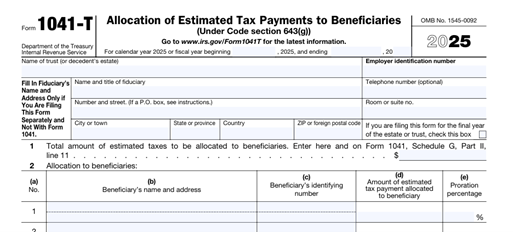
This all makes sense to Igor, and he discovers that the process for making this allocation is fairly straightforward. There is a simple form for it: Form 1041-T, Allocation of Estimated Tax Payments to Beneficiaries. The form must be filed by the 65th day after the close of the trust’s tax year. This lines up with the deadline to make 65-day distributions to beneficiaries under Code Section 663(b), about which Igor had already read a very informative and enjoyable article not too long ago. This is logical, because it matches the trustee’s ability to allocate estimated payments to a beneficiary with the ability to make distributions after the trust’s year-end to carry out taxable income from the trust. Here is what the top of the form looks like for reference:
Igor uncovers one last surprise when researching tax forms: the government is changing over to only electronic payments. This is an interesting wrinkle because trusts cannot use the IRS Direct Pay system like individuals. Instead, they either have to wire a payment from their bank account or set up an account through the EFTPS system. This latter he has done before for a business, so he realizes that it will take 7-10 days to set up, because the IRS mails out a PIN via snail mail. As of early 2026, the IRS guidance is that they will continue to accept paper checks for now, but the tone suggests that the paper check option will not be available for much longer. This is a situation that requires monitoring, but he decides to begin setting up EFTPS accounts to make sure he stays on top of things.
After all this, Igor can tell the doctor is pretty much checked out and is going to leave all the decisions up to Igor as usual. But that is ok, because Igor knows he has at least run through all these scenarios, so the doctor cannot say he kept him in the dark. Below are his notes for things to follow up on:
Igor’s Summary of Action Items:
Make sure to send in safe harbor payments for all trusts using Form 1041-ES.
Take a look at all the trusts’ income to see if annualizing makes sense and/or can help anything, particularly if there is December income on which it is not necessary to include in estimated payments.
Keep an eye on whether it is helpful to use Form 1041-T to pass out estimated payments to beneficiaries, particularly in cases where 65-Day payments are being implemented.
Monitor IRS alerts to be aware of when electronic payments become fully required as the transition period ends.